CEO’s Question:
“Why does our organization feel both overmanaged and under managed at the same time? ”
Why This Question Matters
Many CEOs sense that something is off in their organization, even when roles look clear on paper. Decisions are either pushed too far up the organization or made too far down.
Managers complain they are in the weeds, while employees feel either micromanaged or unsupported.
These symptoms are rarely caused by people or effort. More often, they are the result of getting the levels of work wrong.
Organization design is not an art. It is a science. And that science is grounded in the concept of complexity of work.
Complexity of Work and Time Span of Discretion
The foundation for understanding organization design comes from the work of Elliott Jaques, particularly his concept of time span of discretion, as described in Requisite Organization.
Simply put, complexity of work increases as the time horizon over which a person must think, plan, and make decisions extends further into the future. The longer the time span of discretion, the more complex the work.
This is what determines levels of work in an organization, not job titles or reporting relationships.
Level 1 Work: Declarative and Procedural
Level 1 work is the foundation of execution in most organizations.
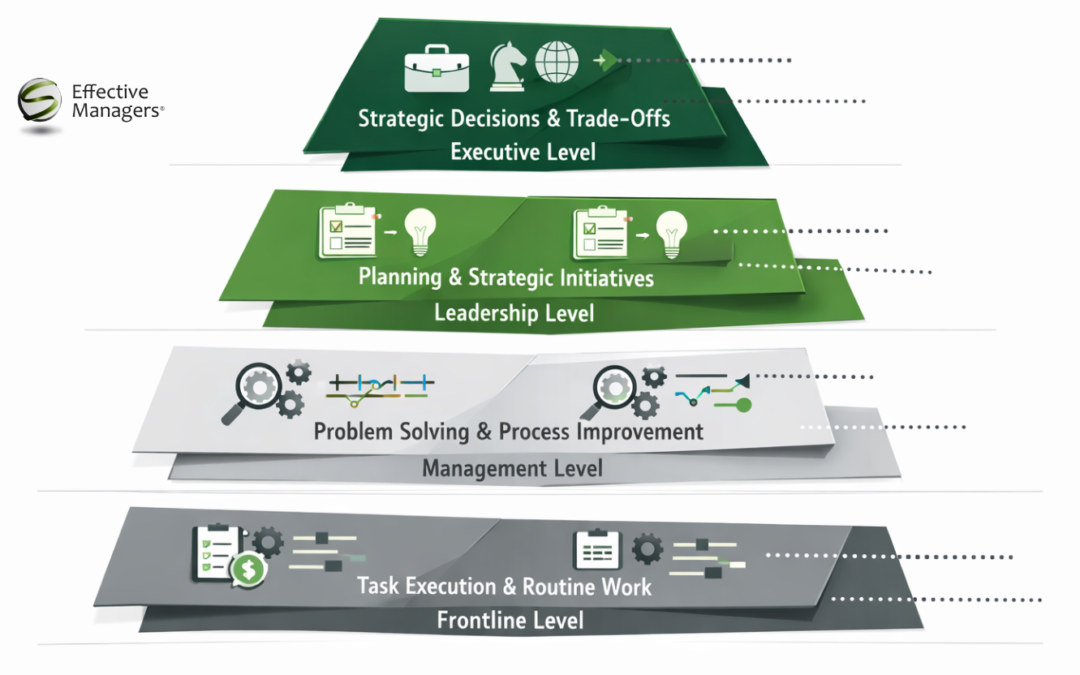
It is declarative in nature and involves following established procedures and standards. Decisions are finite. There is a clear right way to do the work, and success comes from accuracy, consistency, and reliability.
Time span is short, typically day to day but could be up to three months.
Examples include frontline roles where work is assigned daily or weekly and performance depends on doing tasks correctly and on time.
When Level 1 work is not clearly defined or properly supported, organizations experience errors, rework, and frustration at the front line.
Level 2 Work: Diagnostic and Cumulative
Level 2 work is fundamentally different.
Rather than following procedures, Level 2 work requires diagnostic capability. The decision set is infinite. Problems are not solved by applying a single right answer, but by analyzing patterns, identifying root causes, and making judgments.
Time span extends from three months up to one year.
Level 2 managers improve processes, solve recurring problems, and ensure that Level 1 work becomes more reliable over time. This work is cumulative, building capability and performance incrementally.
In professional services organizations, Level 2 work is the primary level of execution. Providing value to clients requires diagnosing unique situations and tailoring solutions accordingly.
As a result, these organizations must be designed around Level 2 direct outputs work.
While the problem-solving capability required is similar across organizations, professional services are inherently more complex because diagnostic work sits at the core of value creation.
Level 3 Work: Serial Processing
Level 3 work introduces serial processing.
Here, the role requires building paths into the future, one to two years out. Work is no longer about fixing individual problems, but about sequencing initiatives so that one decision or project enables the next.
This level is often seen in heads of functions, directors, or in smaller organizations, the head of the organization itself.
Level 3 managers integrate multiple systems, balance competing priorities, and ensure that today’s actions support tomorrow’s outcomes.
When Level 3 is weak or unclear, organizations struggle with stop start initiatives and lack sustained progress.
Level 4 Work: Parallel Processing
Level 4 work requires parallel processing.
Time span extends from two to five years into the future. The role involves managing multiple functions at the same time and allocating resources across them to support the organization’s strategy.
This level is often found in vice presidents in larger organizations or in CEOs who directly manage several functional leaders.
A critical aspect of Level 4 work is making trade-offs. One function may need additional resources while another receives fewer, even when that decision feels suboptimal locally. The decision is made in service of the whole organization, not any single function.
This is enterprise leadership in practice.
Beyond the First Four Levels
Together, these first four levels describe the majority of managerial and leadership work found in most organizations.
In his research, Elliott Jaques identified up to eight distinct levels of work. There can bas as many as eight levels, the highest of which appears only in the most complex organizations in the world. These tend to be very large, multi-corporation, global enterprises such as Sony, Disney, Panasonic, or General Electric.
Most organizations will never require that many layers. The critical issue is not how many levels an organization has, but whether the levels that do exist accurately reflect the complexity of work required to execute the strategy.
Getting this right matters because there is a real cost when levels are either missing or redundant.
When a level is missing, managers are forced to manage through a layer that does not exist.
When a level is redundant, the organization carries unnecessary cost and confusion. Both situations undermine effectiveness, which is why level design is such an important CEO accountability.
The Cost of Missing Levels
A missing level creates a particularly damaging dynamic.
When a level is missing, the manager above must manage through that level while also doing their own work. They are forced into a split role, delegating as if they were one level lower while being accountable as if they were one level higher.
Over time, quality declines. A manager who is more than one level removed from the people doing the work cannot consistently focus on quality, capability development, and performance standards. Eventually, both results and morale suffer.
The Cost of Redundant Levels
Redundant levels create a different problem.
When there is an extra layer in the organization, accountability becomes blurred. People are unclear who their real manager is. Decisions slow down. Authority overlaps.
Costs also rise. Managerial roles are expensive, and having two people performing work that should sit at one level adds unnecessary overhead without improving outcomes.
The organization becomes heavier and less effective.
A Final Thought
Getting the levels right is one of the most important and least understood responsibilities of a CEO.
When levels of work align with the complexity required, delegation becomes clearer, managerial leadership improves, and execution strengthens. When they do not, even the best strategies struggle.
These ideas are drawn from the pioneering work of Elliott Jaques and the continued development of Requisite Organization thinking. I explore their practical application in much greater depth in my book, The Effective CEO: The Balancing Act that Drives Sustainable Performance.
The Effective CEO is available on Amazon in Kindle and paperback editions:
https://www.amazon.ca/Effective-CEO-Balancing-Sustainable-Performance-ebook/dp/B0CVWCQCN1/