The question every CEO eventually asks
“How do I balance it all?”
For most heads of organizations, that question never really goes away. Every day brings competing demands — financial results, customer expectations, operational efficiency, and people needs. And while everyone else can focus on their slice of the business, the CEO must hold the whole system together
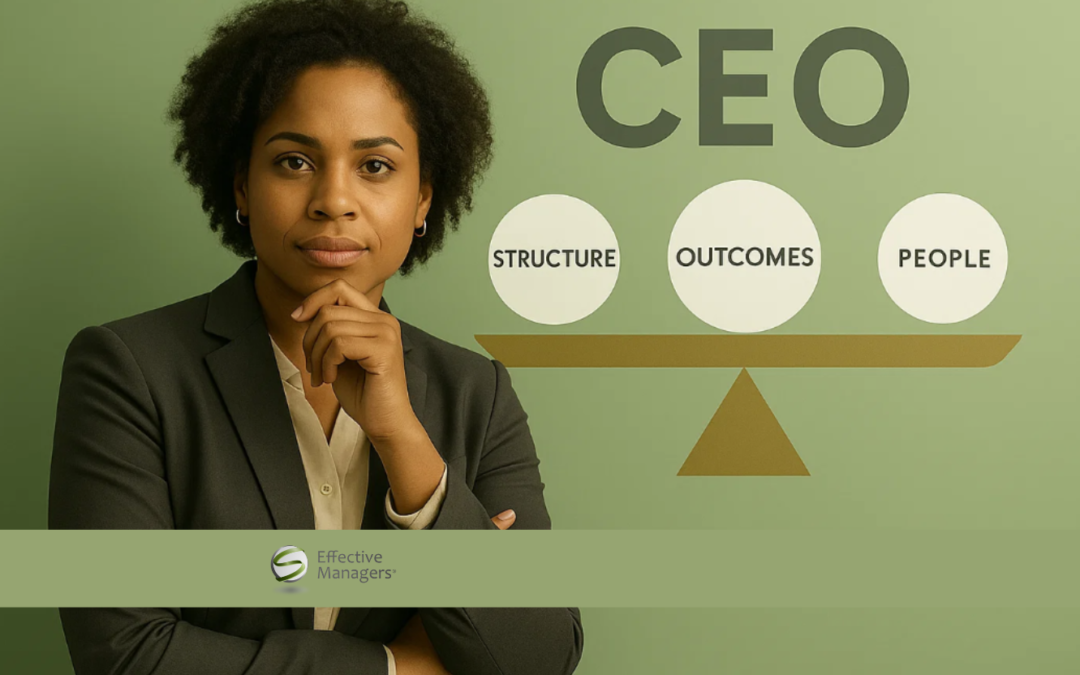
It’s a unique job because it’s the only role that must balance all three dimensions of the organization: structure, people, and outcomes.
The CEO at the intersection
An organization isn’t just a collection of departments or products. It’s a system designed to take inputs from the environment — people, materials, ideas, and capital — and transform them into something of greater value for the outside world.
Within that system, three elements determine how well it performs:
- Structure – the organization’s design, systems, and processes that determine how work gets done.
- People – the managers and teams who bring those systems to life, translating strategy into results.
- Outcomes – the performance, culture, and results that emerge when structure and people are in sync.
The CEO sits at the intersection of these three elements. Only the CEO has the perspective — and the authority — to decide how to balance them. Every trade-off in the organization touches at least one of these areas, and often all three.
Why balance matters
Here’s the trap that even experienced CEOs fall into: over-focusing on one dimension at the expense of the others.
- When structure dominates, organizations become rigid — processes are strong, but innovation suffers.
- When people dominate, morale is high, but direction fades.
- When outcomes dominate, short-term results rise while long-term health declines.
The best CEOs don’t try to optimize any one area in isolation. They balance all three, ensuring each supports the others. Structure should enable people to perform. People should drive the outcomes the structure is designed to deliver. And outcomes should reinforce the systems and culture that made them possible.
That’s the balancing act.
The CEO’s unique accountability
Everyone in the organization contributes to results, but only one person is accountable for the performance of the system as a whole. The CEO can delegate almost every task — but never the responsibility for getting the balance right.
- It’s the CEO who ensures the organization design supports the strategy.
- It’s the CEO who ensures the right managers are in the right roles.
- And it’s the CEO who ensures that outcomes align with purpose and values, not just quarterly numbers.
In that sense, the CEO is both the architect and the steward of the organization’s long-term health.
The challenge — and the opportunity
Balancing structure, people, and outcomes isn’t about finding a static equilibrium. It’s an ongoing process of adjustment. Strategy shifts. Markets evolve. Capabilities change.
The most effective CEOs build systems that stay balanced as conditions change. They develop strong managers, clear accountabilities, and organizational designs that flex without breaking. They focus less on firefighting and more on building the conditions for sustained performance.
And that’s what this blog series is all about: understanding what only the CEO can do to create and sustain a high-performing organization.
Learn More
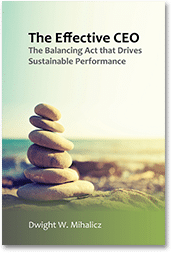
This article draws on the ideas in The Effective CEO: The Balancing Act that Drives Sustainable Performance.
Get your copy on Amazon to explore how CEOs can balance structure, people, and outcomes for lasting organizational success.