CEO’s Question:
“I have strong leaders — but are they really managing?”
Why This Question Matters
It’s a question I hear frequently from CEOs, and it’s an important one. Many organizations are filled with smart, capable, well-intentioned leaders. They communicate well, collaborate effectively, and care deeply about their teams.
And yet, strategy execution remains uneven. Priorities compete. Decisions stall. Performance varies from one part of the organization to another.
The issue is rarely a lack of leadership. More often, it’s the absence of managerial leadership – a discipline that has quietly faded from focus, starting at the very top of the organization.
Leadership Is Not the Same as Management
Over the years, we’ve been taught a convenient but flawed idea: leaders inspire and managers manage.
It sounds tidy, but in practice it causes real harm. It implies that management is administrative while leadership is strategic or visionary. In reality, effective organizations require both, at the same time, in the same roles.
Managerial leadership is not about charisma or motivation. It is about setting context, making decisions, and ensuring work gets done well through others.
The Question CEOs Rarely Ask Themselves
Before asking whether managers throughout the organization are doing their managerial work, I usually turn the question back to the CEO:
Are you doing your managerial leadership work?
Many CEOs expect people to self-manage once the strategy is clear. They assume that a strong strategic plan, a leadership offsite, or alignment around goals is enough.
It isn’t.
If the CEO does not actively set context, clarify priorities, and make enterprise-level decisions, it is unrealistic to expect managers elsewhere in the organization to do so. Managerial leadership does not magically appear at lower levels if it is missing at the top.
Why Functional Filters Get in the Way
Even the strongest executive teams see the organization through functional lenses.
- Finance focuses on cost and risk.
- Sales focuses on growth and customers.
- Operations focuses on efficiency and delivery.
All of these perspectives are valid. None of them are complete.
Only the CEO has a high enough vantage point to decide what is best for the organization as a whole. When that context is not clearly set, managers default to optimizing for their own function. The result is misalignment, friction, and stalled execution.
Managerial leadership is the discipline that integrates these perspectives into clear direction.
What Managerial Leadership Actually Looks Like
Managerial leadership is far more than handing out job descriptions or circulating the strategic plan. It includes the core managerial work that too often goes undone:
- Setting clear context for what matters most right now
- Making decisions that resolve competing priorities
- Delegating work with clear accountability and authority
- Establishing feedback loops
- Removing obstacles so managers can focus on value-added work
This is not abstract theory. At Effective Managers(TM) we have distilled management into a practical and repeatable approach I call the Five Requirements of Effective Managers. Together, they define what managerial leadership actually looks like in practice. When these requirements are consistently applied, managers are far better equipped to translate strategy into execution, align priorities, and lead their teams effectively. When they are missing, even strong leaders struggle to manage well.
The Five Requirements of Effective Managers are:
- Plan
Effective managers have a plan that links, through their own manager’s plan, to the organization’s overall strategic plan. Within that context, they think through and document how they will deliver what has been delegated to them, using the resources available.
- Do
Effective managers manage their subordinates, but they also protect time to do the work that only they, with their capability and in their role, can do. This includes day-to-day management, continuous improvement, and change initiatives. - Set Context and Boundaries
Managers act as the conduit between their manager and their subordinates. Setting clear context ensures decisions and actions align with intent. Boundaries define how work should be done, including policies, values, and the “laws of the land” that must be respected. - Delegate
Effective delegation means assigning the right level of accountability along with the authority required to achieve results. Delegation always sits within the context set by the manager’s manager and is a cornerstone of managerial leadership. - Feedback Loops
Managers rely on accurate information from both internal and external sources to do their work well. Just as importantly, they must provide information. Feedback loops must be two-way to support sound decisions and timely course correction.

For a deeper look at this framework and how it supports managerial leadership at every level of the organization, see The Five Requirements of Effective Managers: https://effectivemanagers.com/dwight-mihalicz/5-requirements-of-effective-managers-2/
When this work is done well, execution improves. When it is neglected, organizations experience churn: too many meetings, rework, missed deadlines, and frustrated people.
Why This Matters More Than Ever
Research consistently shows that poorly managed teams are less productive, less profitable, and more likely to lose good people. At the same time, many managers report being overloaded, under-resourced, and unclear on priorities.
This is not a capability problem.
It is a managerial leadership problem.
And it begins with the CEO modelling the discipline they expect from others.
A Final Thought
If you want better execution, stronger engagement, and more consistent results, don’t start by asking whether your managers are leading enough.
Start by asking whether you are doing the managerial leadership work that only a CEO can do.
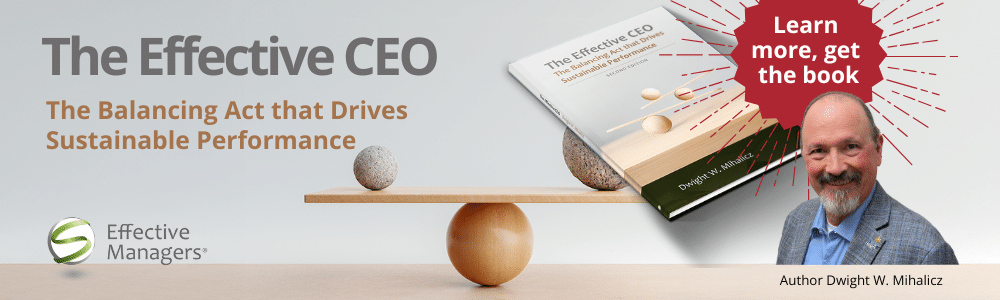
I explore this topic in much greater depth in my book, The Effective CEO: The Balancing Act that Drives Sustainable Performance, where I outline the systems and disciplines required to build organizations that execute reliably, not heroically.
The Effective CEO is available on Amazon in Kindle, eBook and paperback editions:
https://www.amazon.ca/Effective-CEO-Balancing-Sustainable-Performance-ebook/dp/B0CVWCQCN1/