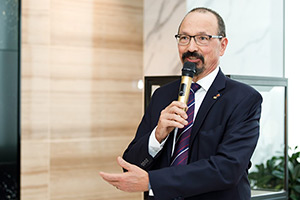
From Corporate Finance to Co-Founding numbercrunch
Dwight Mihalicz: Susan, you’ve built an impressive career in finance and leadership. What inspired you to create a business that delivers complete outsourced financial solutions?
Susan Richards: After years in corporate finance and a few as a fractional CFO, I saw a huge gap in the market. You could hire an accounting firm or a bookkeeping firm, but there was no operational finance team that could step into a company, modernize its systems, set up best practices, and stay alongside the business as it grew.
So I thought, “Why doesn’t this exist?” The only real reason seemed to be a bit of professional snobbery in the accounting world. Bookkeepers did their thing, accountants did theirs, and there wasn’t much collaboration. I wanted to change that.
At numbercrunch, we built something new: a team of bookkeepers, controllers, and CFOs who work together to deliver what I call operational finance. We help companies migrate software, modernize processes, and establish sustainable financial systems. That model simply wasn’t out there before.
From Entrepreneurial Spirit to Business Leadership
Dwight: You’ve made the shift from professional expert to business leader. What drove that transition?
Susan: I’ve always been entrepreneurial. As a teenager, I ran a summer business called Four Seasons Car Care, a name I found on a sign even though I was only open in summer. The spirit was always there.
After university, I spent two decades in corporate roles, but I never stopped dreaming about running my own business. It just took time to find the right idea that passed my own high bar for a viable business model.
My first big leap came when I co-founded Givopoly, a gifting marketplace, in 2012. Two years later, we launched numbercrunch. By then I was in my early 40s and decided it was “now or never.” That sense of timing is personal. For me it was 40, for others it might be 50 or 60. There’s no deadline for starting something that matters.
Building a Culture Worth Coming to Work For

Celebrating being named one of Ottawa’s Best Places to Work.
Dwight: You’ve received several recognitions recently: Best Places to Work, Ottawa’s Most Influential Women. What do those honors mean to you, and what do they say about your culture at numbercrunch?
Susan: I see those awards as a lagging indicator. They reflect years of consistent effort. From the start, I wanted numbercrunch to be a workplace people genuinely enjoy. Work occupies so much of our lives. It should enhance people’s wellbeing, not drain it.
I’ve always had a “help, don’t hinder” philosophy. My goal is for our environment to make people’s lives better for both employees and clients. When our people thrive, our clients feel that energy.
I also learned I can’t define the right environment on my own. Our team tells us what matters most. They’ve kept me and my co-founder on our toes for 11 years, shaping the culture as we grow.
When we finally applied for Best Places to Work, I hesitated. It took courage to put ourselves forward. But the recognition validated what we’d been building all along.
Giving Back Beyond the Balance Sheet
Dwight: You’ve also been recognized for community leadership. What motivates your community involvement?
Susan: I believe everyone who can contribute, should. The phrase “give back” doesn’t quite capture it for me, because I’ve always felt called to serve, not just to repay.
There are so many ways to give. Something as simple as donating blood matters, because not everyone can do it. It’s self-reinforcing. Helping others feels good and builds a sense of community.
My dream is that everyone finds one small way to contribute beyond their job and family responsibilities, something that matches their interests and strengthens the community. When that happens collectively, we reduce how many people fall through the cracks.
I’ve been fortunate to have a platform where I can use my network to help. That sense of responsibility motivates me every day.
Common Pitfalls in Financial Management
Dwight: From a business standpoint, what mistakes do leaders often make in managing their financial functions?
Susan: The biggest surprise for me was realizing that big companies can be just as messy as startups. I used to think they had everything figured out. Then I saw behind the scenes.
Most entrepreneurs don’t start businesses because they love financial management. Their strengths lie elsewhere. But without reliable financial systems, the business can’t scale. You need solid reporting, forecasting, and insights, not just compliance bookkeeping.
The most common mistake is waiting too long to fix it. Leaders often tolerate disorganized systems until they hit a wall. Without professional help to clean up and modernize, the business stays stuck at the ceiling of its founders’ financial confidence.
Repositioning Outsourced Finance
Dwight: You’ve recently repositioned numbercrunch around full-service outsourced finance. How does that work in practice?
Susan: We developed what we call the Finance Growth Engine. It’s a framework that helps us assess each client’s current state and chart where they need to go.
It starts with the basics: clean, accurate books and reliable reporting. Then we move into insights – turning data into understanding – and finally navigation, which means using that insight to plan and test future scenarios.
Whether a company is small, mid-sized, or larger, the framework applies consistently. It allows us to compare performance and prescribe what they should focus on in the next 12 months. It’s the culmination of decades of experience, distilled into a method we can apply across industries.
Habits of an Effective Leader
Dwight: What habits or traits have been most important to your success as a leader?
Susan: Three stand out: ruthless focus, happiness, and rituals.
Focus is essential. I have to stay in my lane and trust others to stay in theirs. I call it ruthless focus because it requires discipline. It means saying no to things I could do, but shouldn’t.
Happiness is a leadership strategy for me. I believe in an active positive bias. People perform better and stay longer when they feel fulfilled. Work should contribute to happiness, not wait for weekends.
And rituals. They are my anchor. Predictable habits create stability and trust. Personally, I integrate movement, reflection, and learning into my day: a few yoga stretches between meetings, a podcast during drives. Company-wide, we have shared rituals like team lunches and professional development sessions. These small, repeated moments build culture.
Diversity and Belonging at Work
Dwight: You’ve also emphasized building diverse, high-performing teams. What have you learned about that?
Susan: I’m still learning every day, maybe halfway through my “cup,” as I like to say.
Diversity doesn’t happen by accident; it has to be intentional. Canadians are wonderfully polite, but that politeness can hold us back from asking questions that build understanding. At numbercrunch, we use food as a bridge to celebrate cultural holidays with shared meals and potlucks.
We also value our immigrant workforce deeply. People who come to Canada bring gratitude, focus, and a strong work ethic. They care deeply about contributing, and that attitude is contagious.
The Future of Outsourced Finance
Dwight: Looking ahead, how do you see outsourced financial services evolving?
Susan: I’m confident this is the model of the future. When we started numbercrunch 11 years ago, outsourced finance barely existed. Today it’s well-established, and I think it’s only going to expand.
We’re entering what I call results as a service. Clients care less about the activities and more about the outcomes they can rely on. Technology, including AI, is moving fast, but people remain essential. Every business has anomalies, and humans are far better at interpreting them.
So the future will be a blend of automation and human judgment. Our people will be smarter, our tools more powerful, and our relationships deeper. It’s about becoming strategic partners, not just back-office support.
Peer Learning and Personal Growth
Dwight: You’re a member of a TEC Canada peer group. How has that experience influenced your leadership?
Susan: It’s been transformative. TEC was the first thing I joined purely as myself, not as a CFO or founder. It gave me a space to integrate all those roles into one identity.
Before TEC, I didn’t even think of myself as a leader. Through the group, I began researching what leadership meant, and my peers reflected examples of my leadership back to me. That feedback was powerful and it gave me confidence and clarity.
I learned that leadership isn’t about title; it’s about self-awareness and accountability. TEC became my mirror and my accountability framework. It’s still helping me grow.
Rapid Fire Round
Dwight: What’s a recent book or podcast that’s influenced you?
Susan: EdUp Canada, hosted by Michael Sangster. It focuses on career colleges across Canada and offers real insights into education, demographics, and workforce trends.
Dwight: Leadership in one word?
Susan: Joyfulness. Or maybe joyful responsibility. Leadership should energize, not exhaust.
Dwight: Finish this sentence: “Success, to me, looks like…”
Susan: Good vibes. It’s the energy of a healthy, happy team. When I feel it, and the people around me feel it, that’s success.
Dwight Mihalicz: That’s a wonderful definition to end on: success as shared energy. Thank you, Susan, for sharing your story, your philosophy, and your optimism for what’s ahead.
Learn More
As a TEC Chair, I would be delighted to explore your fit with TEC and help you find the peer group that is right for you, whether that is my group or another across the TEC Canada network. Please feel free to reach out.
Learn more about TEC Canada and all the options for peer groups. If you are the head of the organization, a key executive, or an advancing leader, there is an option for you.