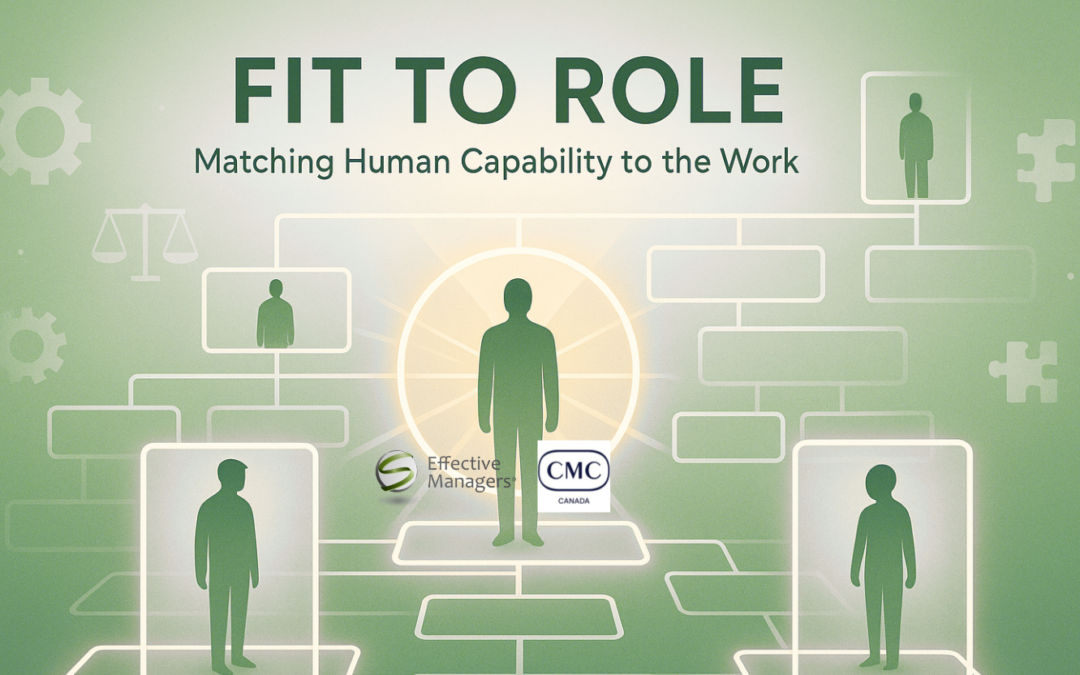
Even the best-designed organization will fail if people are not in roles that match their capability. I see this in every sector. A manager is overwhelmed by decisions that seem too complex. A high-performing employee is promoted and quickly burns out. A senior leader spends time redoing work that should have been delegated. These are not motivational issues. They are fit-to-role issues.
The Science of Fit
Elliott Jaques’ research showed that human capability grows over time. He described this as problem-solving capability—a person’s ability to handle increasing levels of complexity and uncertainty. This capability must match the complexity of work in the role.
When a person’s capability fits the role, they thrive. Their work feels challenging but achievable. They can make sound decisions, anticipate problems, and plan effectively within the role’s time span of discretion. When the fit is wrong, both the individual and the organization suffer.
Too Big or Too Small
A mismatch can occur in two directions.
When the role is too complex, the individual feels overwhelmed. They struggle to make decisions and rely on constant guidance from their manager. Results suffer, and confidence erodes.
When the role is too small, the person becomes frustrated and disengaged. They see what needs to be done but lack the authority or scope to do it. Over time, they lose interest or leave for a better fit elsewhere.
Neither situation serves the organization. Both reduce effectiveness and create turnover in key positions.
The Manager’s Role
Every manager is accountable for ensuring their team members have the capability and resources to succeed. This means understanding the level of work in each role and matching people accordingly. It also means looking beyond technical skills and experience to assess true problem-solving capability.
Fit to role is not static. As people develop, their capability increases, and they can take on more complex work. Effective managers plan for this growth and delegate progressively, giving employees opportunities to stretch within safe boundaries.
Fit Drives Performance
When capability and complexity align, organizations perform at their best. People are clear about what they are accountable for, motivated by meaningful challenge, and supported by managers who add value to their success. This alignment is the foundation of sustainable performance.
Learn How to Apply the Science
If you would like to explore how to assess capability and improve fit to role in your client organizations, join me for the CMC Canada Master Class: “Beyond the Org Chart – The Science and Art of Organization Design.”
In this two-hour session, I will demonstrate how to connect human capability to organizational complexity and design roles that work.