Most leaders are surrounded by people who need answers.
Their teams need direction. Customers need decisions. Suppliers need responses. Owners need results. Even well-meaning colleagues often come with questions, updates, and immediate concerns that pull the leader toward action.
That is part of the job.
But it creates an important risk.
When a leader is always in the position of responding, deciding, and solving, they do not always have enough space to be challenged in the right way. They may get plenty of input, but not enough stretch. Plenty of information, but not enough perspective. Plenty of pressure, but not enough thoughtful challenge.
And yet that challenge is often exactly what helps a leader grow.
The best leaders do not just look for support. They look for people who help them think bigger.
Bigger thinking starts with better questions
When a leader brings forward an issue, the first version of the problem is often not the real problem.
That is not because the leader is missing something obvious. It is because the issue usually arrives in its symptomatic form.
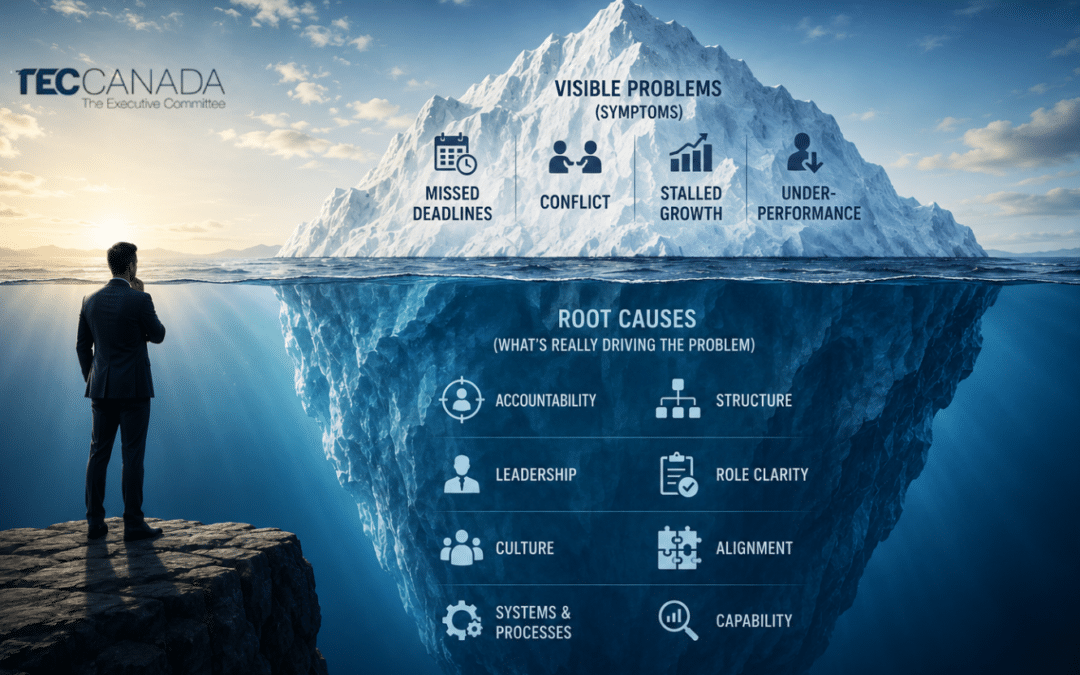
A team member is underperforming. A department is missing deadlines. A conflict keeps resurfacing. Growth has stalled. Communication feels unclear. Execution is inconsistent.
These are real issues, but they are often symptoms before they are root causes.
When a leader is buried in the day-to-day, the natural instinct is to solve the symptom. That makes sense. The symptom is visible. It is pressing. It creates discomfort. Just like a headache, the immediate instinct is to reach for a pain reliever.
The trouble is that the pain reliever may quiet the problem without solving what caused it.
The same thing happens in organizations all the time.
An issue gets addressed at the surface level. Things settle down for a while. Then the same problem returns, perhaps wearing a slightly different hat, but still very much alive.
That is why bigger thinking often begins with a challenge, not an answer.
It begins when someone asks, “What is really going on here?”
Why leaders need challenge, not just encouragement
Encouragement is valuable. So is reassurance. Leadership can be demanding, and every leader needs trusted people around them.
But encouragement alone is not enough.
A leader also needs people who are willing to press a little deeper. People who can ask the harder question. People who are not satisfied with the first explanation or the most comfortable interpretation.
That kind of challenge is not about criticism. It is about clarity
.
In my experience as a TEC Chair, it is common for a member to bring an issue to the group and describe what appears to be the problem. After some discussion, and after the group asks a series of thoughtful and sometimes difficult questions, the conversation often shifts. What first appeared to be the issue is revealed to be something more symptomatic than foundational.
That is where the value begins.
The leader starts to see the root cause more clearly. They begin to understand what is driving the pattern underneath the visible issue. And once that happens, the quality of their thinking changes.
They are no longer just trying to make the pain go away.
They are thinking more deeply about how to solve the real problem.
Thinking bigger is not just about scale
Sometimes people hear the phrase “think bigger” and assume it means more growth, more revenue, more expansion, or a bolder strategic move.
It can mean those things.
But in leadership, thinking bigger often begins one step earlier. It means seeing beyond the immediate issue to the larger system around it. It means recognizing that a repeated problem may be telling you something important about structure, accountability, leadership, clarity, capability, or culture.
That is a bigger level of thinking.
It is the shift from asking, “How do I fix this problem today?” to asking, “Why does this keep happening, and what has to change so we stop solving the same problem over and over again?”
Once a leader begins thinking that way, something important happens.
They start to reclaim time and energy from the business instead of being endlessly pulled into it.
They become less reactive.
They begin to focus more on the value-added work that belongs in their role.
And from there, they are in a stronger position to think about the future, growth, opportunity, and what is truly possible for the organization.
So yes, thinking bigger includes the horizon. But it also includes depth.
The danger of living at the symptomatic level
Many organizations get stuck because their leaders are forced into a constant cycle of symptom management.
A problem shows up. It gets handled. Another appears. That gets handled too. The leader becomes highly skilled at dealing with visible issues, but the underlying causes remain in place. Over time, this creates fatigue, frustration, and a sense that progress is harder than it should be.
It also limits growth.
If a leader is always pulled back into recurring issues, they have less capacity to focus on strategy, leadership, innovation, and organizational development. The business keeps them busy enough to prevent them from building what comes next.
That is one of the hidden costs of not being challenged deeply enough.
Without the right questions, leaders can become very efficient at solving the wrong level of problem.
And that is not a small issue. It affects how the entire organization performs.
How a peer group stretches a leader’s thinking
This is one of the great strengths of a strong peer advisory group.
A good peer group does not simply sympathize. It does not rush to offer quick advice. And it does not let a leader stay too comfortably inside the first version of the story.
Instead, it helps the leader think more clearly.
In a TEC Canada group, members bring their experience, judgment, and perspective to the table. They ask questions that challenge assumptions. They test whether the issue being discussed is really the issue. They help one another separate symptom from cause, reaction from reflection, and immediate pressure from larger possibility.
That process can be incredibly powerful.
A leader may come in focused on a problem with one person, one decision, or one operational issue. By the end of the discussion, they may realize the real issue is role clarity, executive alignment, management practice, accountability, or a structural problem that has been quietly driving the symptom all along.
That is not just helpful. That is leadership leverage.
Because once a leader sees the issue at the right level, they can act at the right level.
And once they start doing that consistently, they create the space to think bigger in every sense of the phrase.
Who is helping you see beyond your current limits?
That may be the most important question in this article.
- Who in your world is helping you think beyond the obvious?
- Who asks the question that makes you stop and reconsider your assumptions?
- Who challenges you to look past the symptom and into the underlying pattern?
- Who stretches your view of what is possible for your organization, and for your own leadership?
- For many leaders, that kind of challenge is rarer than it should be.
Inside the organization, people may hesitate to push too hard. Outside the organization, conversations can stay general or polite. Even trusted advisors may focus more on support than stretch.
That is why a true peer group matters.
The right peers do not challenge you to make you uncomfortable for the sake of it. They challenge you because better thinking leads to better decisions. And better decisions create stronger organizations.
Final thought
The best leaders do not seek comfort. They seek clarity.
They want support, of course, but they also want challenge. They understand that growth does not come only from having answers. It also comes from being willing to question whether the problem, the opportunity, or the limit is really what it first appears to be.
That is one of the most valuable things a peer advisory group can offer.
It helps leaders move beyond symptom-solving and toward deeper insight. It helps them think at the root-cause level. And it helps them see more clearly what is possible when they are no longer trapped inside the immediate pressure of the business.
As a TEC Chair, I have seen this happen many times. A leader arrives with a problem that feels urgent and concrete. Through thoughtful challenge, the group helps uncover something larger, deeper, and far more important.
Often, that is the moment when real progress begins.
Because sometimes the biggest breakthrough is not getting a better answer.
It is being challenged to ask a better question.
Learn more about TEC Canada and all the options for peer groups.
Click here to explore.