CEO’s Question:
How can I delegate without losing control or being disappointed?
That is one of the most practical questions any CEO or manager can ask.
Delegation is essential in organizations. Without it, work bottlenecks, decision-making slows down, managers become overloaded, and people lower in the organization never fully grow into their roles. Yet many leaders struggle with delegation because too often it goes wrong. Work comes back incomplete. Decisions are made poorly. Timelines slip. Standards are missed. Before long, the manager decides it is easier just to do it themselves.
That is understandable, but it is not sustainable.
Good delegation is not about letting go carelessly. It is about creating the conditions for other people to take on work successfully while the manager still retains appropriate accountability for the result.
That begins with context.
In the previous article, I talked about the importance of setting context. Context matters because it gives people enough understanding of the purpose, priorities, boundaries, and expectations around the work so that they can use judgment without constantly checking back. If managers in the organization do not have the context they need, they will either hesitate, escalate too much, or make weaker decisions than they should.
So before delegation can work well, context has to be in place.
And that is not a one-time event. The manager of managers throughout the organization is accountable for making sure the right context is set at each level. If the context is not producing the right level of judgment and initiative, then the answer is not always tighter control. Sometimes the answer is better context.
Once that foundation is in place, delegation can become much more effective.
One of the most useful frameworks I know for this comes from Elliott Jaques in The Requisite Organization. It provides a clear way to delegate specific outcomes with specific time frames in a way that improves clarity and reduces disappointment.
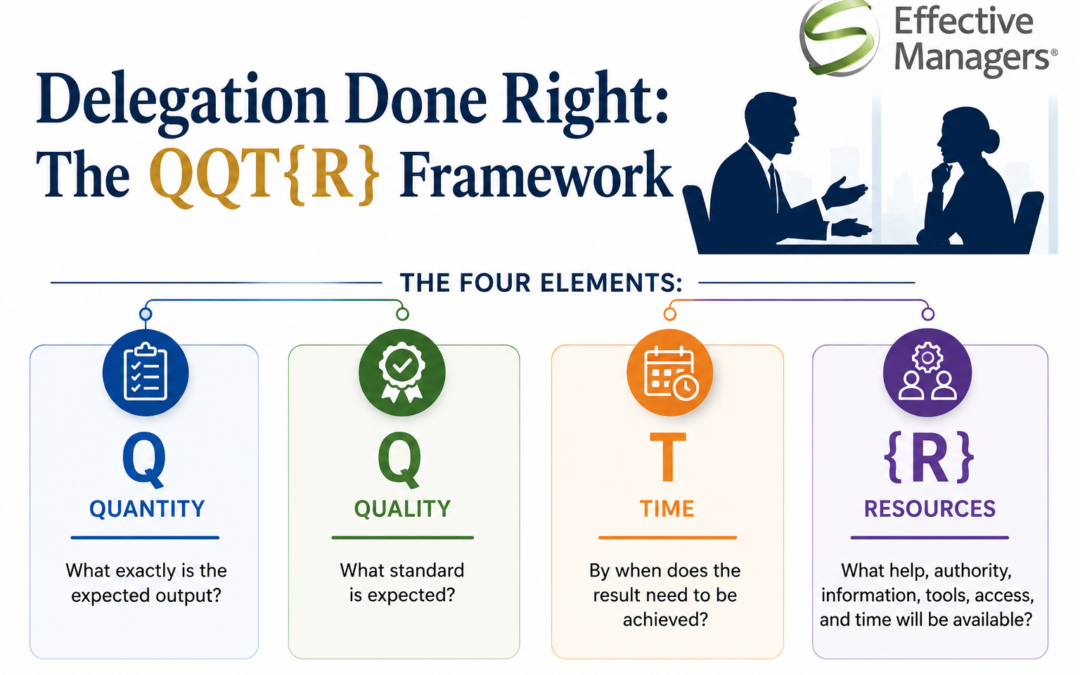
That framework is QQT{R}.
It gives managers a disciplined way to think about what they are delegating and what the other person needs in order to succeed. It also helps prevent one of the most common delegation problems, which is vague assignment. A manager says, “Can you take care of this?” and assumes the other person understands exactly what is expected. Often, they do not.
QQT{R} helps fix that.
The four elements are: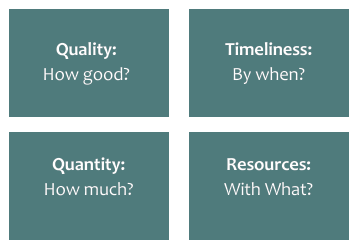
- Quantity
- Quality
- Time
- Resources
Each one matters.
Why Delegation Often Goes Wrong
Before looking at each part of QQT{R}, it is worth pausing on why delegation so often fails.
Usually, it is not because the person receiving the work is incapable.
More often, the delegation itself was incomplete.
The manager may have been clear about the task, but not about the standard. Or clear about the deadline, but not about the scale of the expected result. Or clear about the result but vague about what support or resources were available. In some cases, the manager delegated the action but did not provide enough context for good judgment along the way.
Then the manager is disappointed, and the other person feels they were set up to fail.
That is why delegation has to be more deliberate than simply passing work across the table.
Done properly, delegation is one of the best ways to strengthen accountability, improve responsiveness, and help people grow in capability. Done poorly, it creates confusion, frustration, and rework.
QQT{R} gives managers a much better chance of doing it properly.
Quantity
The first element is quantity.
What exactly is the expected output?
This sounds simple, but it is often where delegation starts to drift. The manager has a picture in mind of what they want, but the other person only has a rough sense of the task. They may understand the topic, but not the scale.
Does the manager want one recommendation or three options? A high-level summary or a full report? A short client response or a detailed proposal? A pilot in one area or a full rollout across the business?
If the quantity is unclear, the person doing the work has to guess.
Sometimes they do too little and disappoint the manager. Sometimes they do far more than was needed and waste time and effort. Neither is ideal.
Good delegation requires the manager to be clear about the amount or scope of output expected. It does not always have to be mathematically precise, but it should be clear enough that the person knows what a complete result looks like.
Quantity helps answer the question: how much is enough?
Quality
The second element is quality.
What standard is expected?
This is where many managers assume too much. They believe the other person knows what “good enough” means, but unless that standard has already been established clearly, there is a real risk of mismatch.
Quality includes things such as accuracy, thoroughness, presentation, usefulness, reliability, and fit for purpose. The right quality level may vary depending on the nature of the task. A first draft for internal discussion does not need the same polish as a client-ready document. A quick operational fix may not require the same analysis as a strategic recommendation.
The manager needs to be clear about the standard required for this piece of work.
That does not mean micromanaging every detail. It means making sure the person understands the level of finish, care, and judgment expected.
Quality helps answer the question: what standard does this need to meet?
Timeliness
The third element is about the timeliness of the deliverable.
By when does the result need to be achieved?
This is not just about the final deadline. It is also about the timing context around the work. Why does that date matter? Are there interim checkpoints? Is the deadline fixed or somewhat flexible? Are there dependencies with other people or other projects that make timing important?
Time is one of the most misunderstood parts of delegation because managers often think they have been clear simply by stating a due date. But if the person does not understand the significance of the timing, they may treat it like any other task competing for attention.
In addition, timing should match the complexity of the assignment. If the time frame is unrealistic, delegation becomes a setup for failure. If it is too loose, momentum can be lost.
Clear delegation requires a shared understanding not only of the date, but of the timing expectations around the work.
Time helps answer the question: when is this needed, and how firm is that expectation?
Resources
The fourth element is resources.
What help, authority, information, tools, access, and time will the person have available to complete the work?
This part is often neglected, but it can make all the difference.
A manager may delegate a task with a clear quantity, quality, and time frame, but if the person does not have access to the right data, support, budget, people, systems, or decision rights, the work will stall. Then the manager concludes that the individual was ineffective when the real problem was that the delegation did not equip them properly.
Resources can include practical things such as budget, systems, materials, contacts, expertise, staffing support, or access to key information. It can also include authority. Who can they involve? What decisions can they make on their own? What should they escalate?
But one of the most important resources is time.
Does the person actually have the time to devote to this work? Can they realistically give it enough attention to deliver the expected quantity, at the required quality, within the required time frame?
It is very easy for a manager to download another priority onto someone without fully understanding what that means in relation to everything else already on that person’s plate. That is why the manager doing the delegating needs to initiate that conversation. They need to understand the competing priorities, the capacity available, and whether trade-offs need to be made.
Time is a non-renewable resource. If it is not properly taken into account, delegation can look clear on paper but still fail in practice.
Delegation is not complete until the manager has thought through whether the person actually has what they need to succeed.
Resources help answer the question: what will you have available to get this done?
Why QQT{R} Matters So Much
What makes QQT{R} so useful is that it turns delegation into a more disciplined management practice.
It helps the manager think clearly before assigning the work. It gives the other person a better understanding of what is expected. And it reduces the chances that disappointment later will really be the result of vagueness at the beginning.
That matters because delegation is not just a matter of efficiency. It is one of the main ways organizations build capability.
When managers delegate well, they strengthen decision-making at the right levels. They help people grow into larger responsibilities. They create better use of managerial time. They reduce unnecessary escalation. And they make it more likely that the organization can perform reliably without constant intervention from above.
Poor delegation does the opposite. It reinforces dependency. It trains people to wait. It keeps managers too deep in work that should sit elsewhere. And over time, it weakens the whole organization.
That is why delegation done right is such an important discipline.
A Practical Point for the CEO
For the head of the organization, this issue goes beyond personal delegation.
The CEO should certainly delegate clearly in their own role. But just as importantly, the CEO should ensure that delegation is understood and practiced throughout the organization in a consistent way.
If managers are not setting context well, delegation will remain weak. If managers are not clear about QQT{R}, work will continue to come back unevenly. If there is no common discipline around delegation, then accountability and authority will stay muddled and the organization will depend too heavily on escalation.
Good delegation should cascade.
And when it does, the effect is significant. People become clearer. Managers become more effective. Decisions move closer to the work. The organization becomes less fragile and more capable.
Final Thought
Delegation is not about losing control.
It is about creating the right kind of control.
The goal is not to hold on to every decision or every task. The goal is to ensure that work is delegated clearly enough, with the right context and the right expectations, so that others can take it on successfully and the manager can remain confident in the result.
That is why context matters first.
And that is why QQT{R} is so useful.
When managers are clear about quantity, quality, time, and resources, delegation becomes much more effective. It becomes fairer to the person receiving the work, more reliable for the manager, and more useful for the organization as a whole.
That is what delegation done right looks like.
Learn more about implementing a clear delegation process by using the Value Added Plan™. Value-added planning is a process you can use this process to create a standard context that flows down throughout the organization, ensuring that each person is focused on their value-added work, is making appropriate decisions, and has been clearly delegated specific projects.
The guide is designed as a practical tool set in an 8.5 by 11 format so that heads of organizations and any manager inside the organization can use it in a cascading way.
Explore the guide here: When Strategy Doesn’t Deliver: A Guide to Value-Added Planning