What if there were a simple formula that could explain why some organizations get so much more performance from their people than others?
Most of us remember Einstein’s famous equation, E = mc², even if we have not thought much about the science behind it since school. The concept is called mass-energy equivalence. In simple terms, Einstein showed that mass contains an extraordinary amount of energy because it’s conversion to energy is multiplied by the speed of light squared. The significance is not the arithmetic itself, but the scale. A relatively small amount of mass represents a remarkable amount of potential energy.
I believe there is an organizational parallel. It is certainly not physics. I would not want Einstein chasing me down a hallway for borrowing his formula, but the analogy is useful.
For an organization, I would describe it this way:
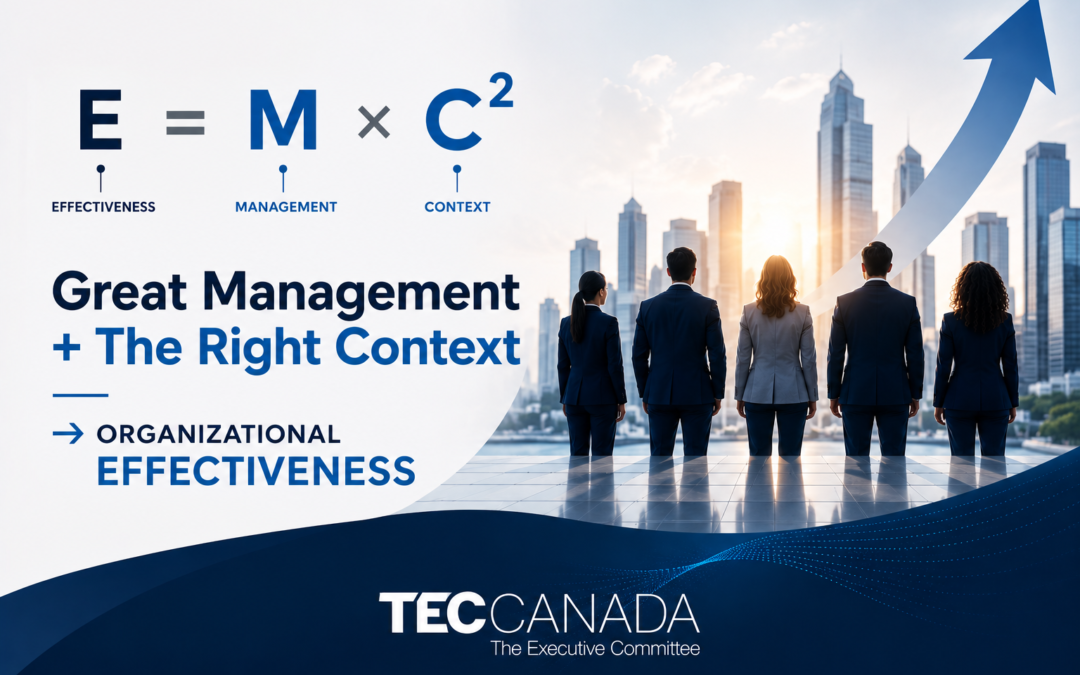
E = M × C²
Where E is Effectiveness, M is Management, and C is Context.
The idea is simple. The effectiveness of individuals, teams, and ultimately the whole organization can be multiplied significantly when managers do their managerial leadership work well and provide people with the context they need to succeed.
That is where enormous organizational energy can be released.
Effectiveness does not come from effort alone
Most organizations are not short of people working hard. In fact, when I work with organizations that are struggling with performance, I often find people who are extremely busy, committed, and trying very hard to get things done.
The problem is that effort and effectiveness are not the same thing.
An employee can work very hard on the wrong priority. A manager can spend enormous energy solving problems that should be handled by someone else. Two departments can each perform well within their own boundaries while unintentionally working against one another. An executive team can be made up of highly capable people and still fail to create the performance the organization should be capable of achieving.
What is missing in many of these situations is not talent or commitment. It is managerial clarity.
People need to understand what is expected of them, why it matters, how their work fits into the larger organization, what priorities should guide their decisions, and where the boundaries of their authority lie. In the language I use in my work, they need context.
When that context is missing, people fill in the gaps themselves. Usually they do so with good intentions, but they interpret priorities through their own experience, their own functional lens, and what seems most urgent at the moment. The result is often wasted effort, duplicated work, unnecessary escalation, and frustration.
When context is clear, the same people can become dramatically more effective.
Context is one of a manager’s most important responsibilities
I use the word ‘context’ very deliberately. Context is not simply giving people instructions. It is helping them understand the environment in which they are expected to make decisions.
A manager needs to make sure that people understand the objectives they are accountable for, the broader priorities of the organization, the standards that must be met, and the boundaries within which they are free to act. They also need to understand why the work matters and how their contribution connects to the work of others.
When people have that context, something important changes. They no longer need to bring every decision back to the manager. They are better able to exercise judgment because they understand what a good decision looks like within the larger picture.
That is why context acts as such a powerful multiplier. It improves not only the effectiveness of the individual, but also the effectiveness of the manager. Instead of spending time constantly correcting, clarifying, and intervening, the manager can focus on the value-added work that belongs in their own role.
Multiply that across every manager in an organization, and the impact becomes significant.
The head of the organization is a manager too
This is particularly important at the top of the organization. We often talk about the CEO or head of the organization as a leader, and rightly so. They need to establish direction, create a compelling vision, inspire confidence, and help the organization move toward the future.
But they are also a manager.
The executive team reports to the head of the organization, which means the head of the organization has managerial leadership work to do with each of those executives. Seniority does not remove the need for management. Highly experienced executives still need context. They still need clarity around their accountability. They still need to understand the authority they have to deliver on that accountability. And they still need feedback on how effectively they are performing their role.
This is where organizations can sometimes get into trouble. There can be an assumption that because someone is an experienced executive, they should simply know what to do. The CEO provides the strategy, everyone nods in agreement, and then the executives go back to their functions.
The difficulty is that each executive naturally sees the organization through the lens of their own accountability. Finance sees financial performance and risk. Operations sees execution and capacity. Sales sees customers and revenue. Human resources sees people and capability. All of these views are necessary, but none of them represents the whole.
It is the responsibility of the head of the organization to provide the context that brings those perspectives together.
Accountability has to cascade through the organization
There is another part of this equation that is just as important. It is not enough for the CEO to do good managerial leadership work with the executive team. Each executive needs to be accountable for doing the same managerial leadership work with their own team, and that expectation needs to continue down through every level of management.
This is where the real multiplier effect begins.
If a manager is unclear about the context they are working within, that lack of clarity is passed on to the people who report to them. By the time the message moves through several layers of the organization, the connection to the original strategy may have weakened significantly.
The opposite is also true. When each manager understands their accountability, has appropriate authority, and consistently provides clear context to the people who report to them, the strategic direction of the organization becomes increasingly embedded in day-to-day decision-making.
People know what matters. Managers can manage. Decisions are made closer to the point where the information exists. The organization becomes less dependent on escalation and intervention.
That is organizational effectiveness in practice.
What happens when performance starts to drift?
Of course, even well-managed organizations encounter problems. A department begins missing expectations. Performance starts to slip. A key initiative loses momentum. Tension develops between two functions. The CEO starts to sense that something is not working as it should.
At that point, the temptation is often to react to the most visible symptom. If sales are down, perhaps the sales team needs to work harder. If operations are struggling, perhaps a process needs to be tightened. If there is conflict between departments, perhaps the two executives simply need to communicate better.
Sometimes that is the answer. Often it is not. The more important leadership question is: what is really causing the problem?
Is the issue external, perhaps driven by changes in the market or competitive environment? Is there a cross-functional breakdown that is making one department look ineffective when the real issue sits between two areas? Is accountability unclear? Has authority been set incorrectly? Or is the head of that function simply not doing the managerial leadership work required of the role?
Those are very different problems, and they require very different responses.
A CEO who solves the symptom may get temporary relief. A CEO who identifies the root cause has an opportunity to improve the organization.
This is where outside perspective becomes valuable
Getting to root cause is difficult when you are inside the situation.
You know the people. You know the history. You may have been involved in some of the decisions that created the current structure. You may also have strong views about what is happening before you begin looking at the issue.
That is where a peer advisory group can provide enormous value.
In a TEC/Vistage group, a leader can bring an issue to people who are far enough removed from the organization to see it differently, but experienced enough to understand the leadership dynamics involved. The conversation can move beyond the immediate symptom and begin testing what is really happening underneath.
A peer may ask whether the executive has actually been given clear accountability. Someone else may question whether the individual has sufficient authority. Another person may recognize a cross-functional issue because they have experienced something similar in their own organization. The discussion may ultimately lead to a much harder conclusion: the leader of that function may not be capable of performing the work required at that level.
That may be uncomfortable, but comfort is not the purpose of the discussion.
The purpose is clarity.
Sometimes effectiveness requires the uncomfortable decision
One of the responsibilities of the head of an organization is to act when the organization is not performing as it should. That sounds straightforward until the issue involves someone who has been with the company for years, someone the CEO likes personally, or an executive who has been successful in the past but is struggling with the complexity of the organization today.
These are not easy decisions.
A strong peer group does not make the decision for the leader, but it helps ensure that the leader is solving the right problem. It helps separate loyalty from accountability, symptoms from causes, and short-term comfort from long-term organizational effectiveness.
Sometimes the outcome will be additional coaching or clearer context. Sometimes accountability needs to be reset. Sometimes the structure needs to change. And occasionally the right answer is that a person can no longer perform the role the organization now requires.
Whatever the answer, the quality of the decision improves when the leader has taken the time to understand what is really driving the problem.
The organizational version of E = mc²
So if I were to borrow Einstein’s equation for management, I would come back to:
E = M × C²
Effectiveness is multiplied by management and context.
It is not intended as a mathematical formula, of course. It is a reminder that organizational performance does not come simply from hiring talented people and expecting them to perform. The management system matters enormously.
Managers need to do their managerial leadership work. They need to set clear accountability, provide appropriate authority, establish context, delegate effectively, and maintain the feedback loops that allow people to understand how they are performing.
The head of the organization needs to do exactly the same thing with the executive team and ensure that this managerial discipline continues all the way through the organization.
When that happens, the potential already sitting inside the organization can be released.
Final thought
There is an enormous amount of potential energy sitting inside every organization. It exists in the experience, judgment, creativity, and capability of the people who work there.
The question is whether the management system allows that potential to be converted into organizational effectiveness.
For me, that starts with good managerial leadership and clear context. When people understand what they are accountable for, have the authority required to deliver, and understand how their work fits into the bigger picture, they can operate at a much higher level.
And when something begins to go off track, the head of the organization needs to be willing to step back and determine the root cause rather than simply treating the symptom.
As a TEC/Vistage Chair, I see the value of peer discussion in exactly these situations. Leaders bring issues that may initially appear operational, but through thoughtful questioning the group often discovers that something more fundamental is happening underneath. Once the root cause becomes clear, the CEO is in a much stronger position to make the decision the organization actually needs, even when that decision is uncomfortable.
Einstein gave us a powerful way of thinking about the energy contained in matter.
For organizations, I would suggest another kind of equation is worth remembering:
Effectiveness = Management × Context².
Get the management and the context right, and you may be surprised by how much organizational energy is already there waiting to be released.
Learn more about TEC Canada/Vistage International and all the options for peer groups.
Click here to explore.